5 Minutes read
Private Limited vs OPC vs LLP: Which Business Structure is Right for You?

Team 720DC

Starting a business in India means choosing the right legal structure upfront. The three most popular options for small and mid-sized ventures are Private Limited Company, One Person Company (OPC) and Limited Liability Partnership (LLP). All three offer limited liability and a separate legal identity. The differences lie in the number of people required, annual compliance load, fundraising ability and running costs.
What Each Structure Actually Is
Private Limited Company: Governed by the Companies Act, 2013. Needs a minimum of 2 shareholders and 2 directors. Can have up to 200 members and 15 directors. Shares are not publicly tradeable. This is the most common structure for startups that plan to raise funding.
One Person Company (OPC): Also under the Companies Act, 2013. Needs just 1 member and 1 nominee. The sole member can also be the sole director. Carries the name suffix "(OPC) Private Limited." Built for solo founders who want corporate protection without needing a co-founder.
Limited Liability Partnership (LLP): Governed by the LLP Act, 2008. Needs a minimum of 2 designated partners, at least one of whom must be a resident of India. No upper limit on partners. Combines partnership flexibility with limited liability protection.
Quick Comparison at a Glance
Feature | Private Limited | OPC | LLP |
|---|---|---|---|
Members Required | Min 2, Max 200 | Only 1 + Nominee | Min 2, No limit |
Directors / Partners | Min 2 directors | Min 1 director | Min 2 designated partners |
Minimum Capital | No minimum | No minimum | No minimum |
FDI Allowed | Yes, automatic route | No | Yes, govt approval |
Liability | Limited to shares | Limited to shares | Limited to contribution |
Mandatory Audit | Yes, always | Yes, always | Only if turnover > 40L |
Board Meetings | 4 per year | 2 per year | Not required |
AGM Required | Yes | No | No |
Governing Law | Companies Act, 2013 | Companies Act, 2013 | LLP Act, 2008 |
3. Compliance: What You File Every Year
Every business entity has annual filings with the Ministry of Corporate Affairs (MCA) or the LLP registrar. Missing deadlines means penalties of Rs 100 per day per form, and directors risk disqualification after three years of non-filing.
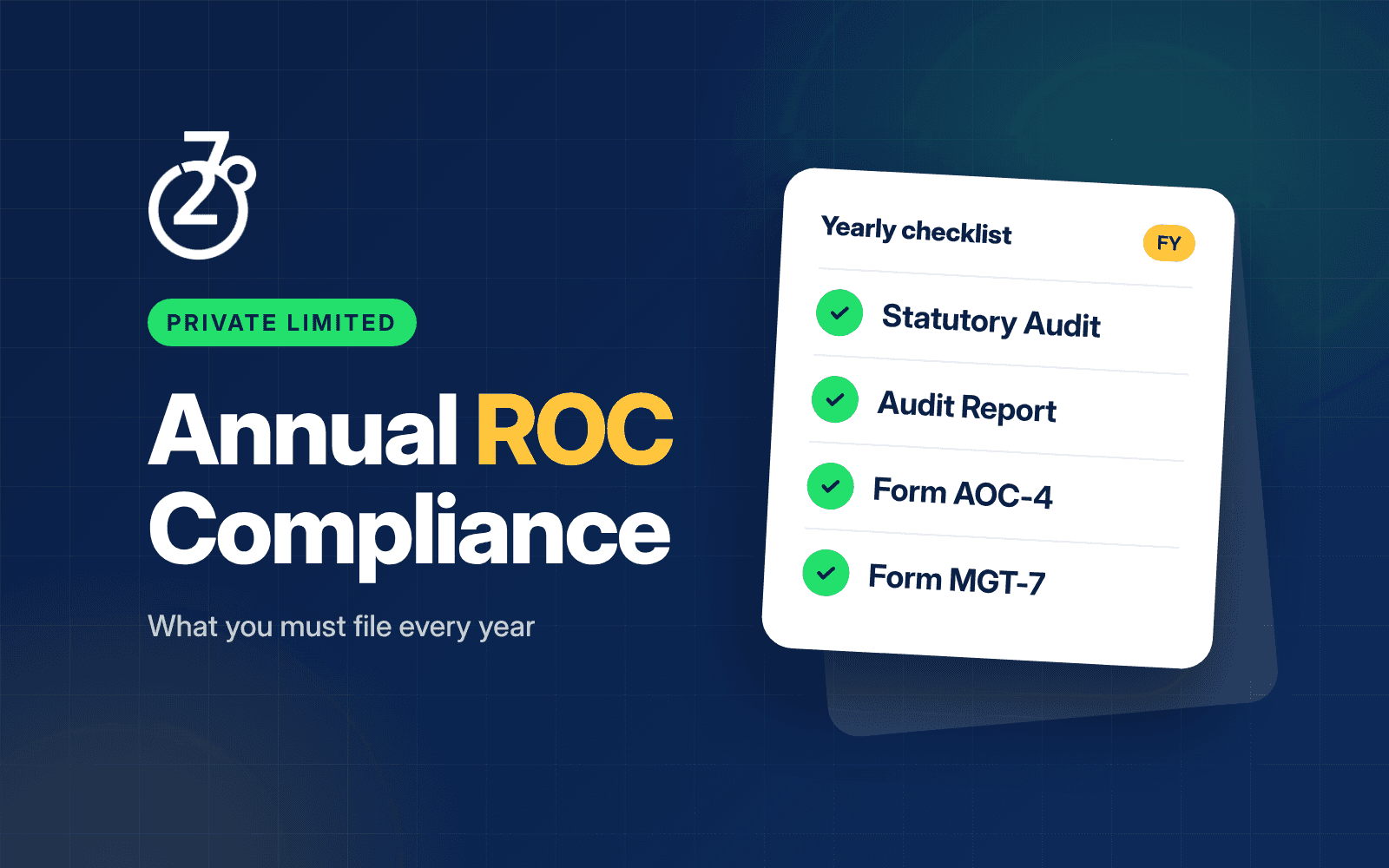
Private Limited Company: File AOC-4 (financials) and MGT-7 (annual return) with MCA, ITR-6 with the Income Tax Department, DIR-3 KYC for every director. Hold 4 board meetings a year and 1 AGM. Statutory audit is mandatory regardless of turnover.
One Person Company: Same MCA forms as a Pvt Ltd (AOC-4, MGT-7A, ITR-6, DIR-3 KYC), but only 2 board meetings a year and no AGM required. Audit is still mandatory.
LLP: File Form 8 (statement of accounts) and Form 11 (annual return) with MCA, plus ITR-5. No board meetings, no AGM. Audit is mandatory only if turnover exceeds Rs 40 lakh or contribution exceeds Rs 25 lakh.
Tax Treatment
Private Limited and OPC both qualify for the concessional tax rate of 25.17% under Section 115BAA of the Income Tax Act (22% base rate + surcharge + cess), provided they forgo exemptions and deductions. Without this option, the standard rate is around 30%.
LLPs are taxed at a flat 30% plus applicable surcharge and cess. They do not get the 115BAA concessional rate. However, partner remuneration and interest on capital are deductible expenses for the LLP, which can lower the effective tax outgo.
What It Actually Costs
Here is a rough cost breakdown so you know what to budget before you incorporate.
Cost Type | Private Limited | OPC | LLP |
|---|---|---|---|
Registration (one-time) | Rs 13,000-20,000 | Rs 13,000-20,000 | Rs 13,000-18,000 |
Annual Compliance | Rs 15,000-20,000 | Rs 15,000-20,000 | Rs 12,000-15,000 |
Which One Should You Pick?
If you are a solo founder looking for minimal compliance and low cost, go with an OPC. You get limited liability without the burden of multiple directors or AGMs. Once your turnover crosses Rs 2 crore or paid-up capital exceeds Rs 50 lakh, you must convert to a Private Limited anyway.
If you are two or more co-founders planning to raise equity funding, a Private Limited Company is the standard. Investors, accelerators, and VCs expect it. The compliance load is higher but the structure is built for scaling, issuing ESOPs, and running a board.
If you are running a professional services firm, a consultancy, or a small business where partners want flexibility without the overhead of company law, an LLP works well. No mandatory audit below Rs 40 lakh turnover, no board meetings, and profits are taxed in partners' hands after deducting remuneration.
7. Can You Convert Later?
Yes. OPC to Private Limited is mandatory once thresholds are crossed, and voluntary conversion is straightforward. LLP to Private Limited is possible under Section 366 of the Companies Act but involves a fresh incorporation, transfer of assets, and a valuation report. Private Limited to LLP conversion is allowed under the LLP Act provided there are no security interests and all partners of the resulting LLP are shareholders of the company. Each conversion has its own compliance timeline and cost, so plan the original structure with growth in mind.
Final Thoughts
There is no universally correct answer. The right structure depends on how many people are involved, whether you plan to raise outside capital, how much compliance you are willing to handle, and what your five-year growth plan looks like. Get the structure right at the start and you save yourself time, money, and a painful conversion down the road. If you are still unsure, talk to a practicing CA or CS before you file your incorporation documents.
Social Links


Newsletter
Subscribe to the Fundely newsletter and receive simple finance tips, helpful guides, and product updates directly in your inbox.