5 Minutes read
Annual ROC Compliance for Private Limited Companies in India: What You Must File Every Year

Team 720DC
Overview
Every Private Limited Company in India has to report to the Registrar of Companies (ROC) once a year. It does not matter whether the company made a profit, a loss, or no sales at all. If the company is on the MCA register, the filings are due.
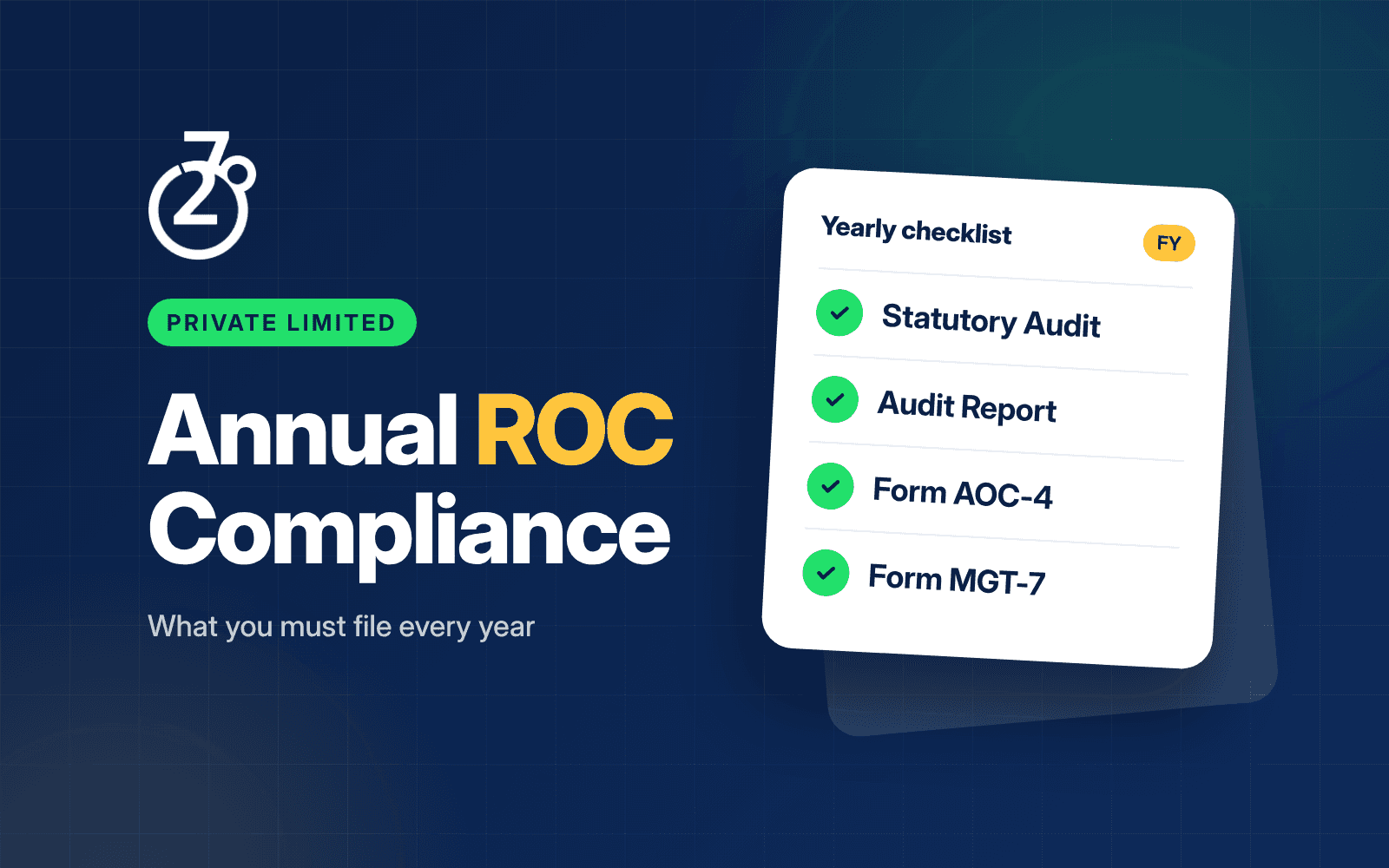
This guide covers the four compliances that apply to every Private Limited Company every year, the deadlines attached to them, and what it typically costs to get them done.
What You Need Before You Start
Two things have to be in place before any of the filings can move.
Books of accounts finalised: Under Section 128, every company must keep proper books of accounts. Before the audit can begin, the year's books have to be closed: bank accounts reconciled, sales and purchase invoices recorded, loans and share capital confirmed, and fixed assets and depreciation updated. The audit cannot start on unfinished books.
Digital Signature Certificate (DSC): ROC forms are signed digitally, not on paper. The director signing the forms needs a valid Class 3 DSC registered on the MCA portal against their DIN. The professional certifying the forms signs with their own DSC. A DSC is issued for a limited period, so check the expiry date well before the due date. An expired DSC stops the filing.
The Four Mandatory Annual Compliances
These four are linked. Each one feeds the next, so a delay at the start pushes everything else back.
1. Statutory Audit
Under Section 139 of the Companies Act, 2013, every company must appoint a practising Chartered Accountant as its statutory auditor and have its books audited each financial year. There is no turnover threshold. A company with zero transactions still needs an audit.
Who does it: an independent practising Chartered Accountant or CA firm
Period covered: 1 April to 31 March
When: after the year closes and before the Annual General Meeting (AGM)
2. Audit Report
The audit report is the auditor's formal opinion on whether the financial statements give a true and fair view of the company's position. It is issued under Section 143 and travels with the financial statements placed before shareholders at the AGM.
Without a signed audit report, Form AOC-4 cannot be filed. This is where most delays begin.
3. Form AOC-4: Financial Statements
AOC-4 is the form used to file the company's audited financial statements with the ROC under Section 137.
What goes in: balance sheet, statement of profit and loss, notes to accounts, the Directors' Report and the audit report
Due date: within 30 days of the AGM
If the AGM is held on 30 September: file by 30 October
4. Form MGT-7 or MGT-7A: Annual Return
The annual return is a snapshot of the company as on 31 March: its shareholders, directors, share capital and the changes made during the year. It is filed under Section 92.
MGT-7: for Private Limited Companies in general
MGT-7A: a shorter version for small companies and One Person Companies
Due date: within 60 days of the AGM
If the AGM is held on 30 September: file by 29 November
Also Required: The Directors' Report
Alongside the audit report, the Board has to prepare its own report for shareholders every year under Section 134. It is called the Directors' Report or the Board's Report. It is not filed as a separate form. It is attached to the financial statements, placed before shareholders at the AGM, and filed with the ROC as part of AOC-4.
It typically covers:
The state of the company's affairs and a summary of financial results
The number of Board meetings held during the year
The Directors' Responsibility Statement
Loans, guarantees, investments and related party transactions
Dividend declared, if any, and amounts transferred to reserves
The Board's response to any qualification or adverse remark in the audit report
The report must be approved at a Board meeting and signed by the Chairperson if authorised by the Board, or otherwise by at least two directors. Small companies and One Person Companies can prepare a shorter, abridged version. Non-compliance carries a penalty of ₹3 lakh on the company and ₹50,000 on every officer in default.
Zero revenue does not mean zero compliance. If the company is on the register, the filings are due.
The Annual Timeline
31 March: financial year ends
April to August: books finalised and statutory audit completed
Before the AGM: Board approves the accounts and the Directors' Report
By 30 September: AGM held and accounts adopted
Within 30 days of the AGM: AOC-4 filed
Within 60 days of the AGM: MGT-7 or MGT-7A filed
What It Costs
For most small and early-stage Private Limited Companies, annual ROC compliance costs between ₹10,000 and ₹25,000 a year. Where a company lands in that range depends on:
Turnover and the number of transactions in the year
How clean the books are at year end
Whether the company qualifies as a small company
Authorised share capital, which decides the government filing fee
What Happens If You Miss the Deadline
An additional fee of ₹100 per day, per form, with no upper limit
Separate penalties on the company and its directors under Sections 92 and 137
Directors can be disqualified for five years if financial statements or annual returns are not filed for three consecutive financial years
Prolonged non-filing can lead to the ROC striking the company off the register
Late fees on the two forms add up to ₹200 a day. A six-month delay costs more than the compliance itself.
Other Filings to Keep on Your Calendar
Depending on your company's situation, these may also apply:
ADT-1: intimation of auditor appointment, within 15 days of the AGM at which the auditor is appointed
DPT-3: return of deposits and outstanding loans, by 30 June
DIR-3 KYC: director KYC, now required once every three financial years instead of every year
MSME-1: half-yearly return if payments to MSME suppliers are outstanding beyond 45 days
Final Thoughts
Annual ROC compliance is predictable. The forms are the same every year and so are the deadlines. Start the audit early, hold the AGM on time, and file AOC-4 and MGT-7 inside the window. The cost of doing it right is small next to the cost of doing it late.
This article is for general information only and is not legal or professional advice.
Social Links


Newsletter
Subscribe to the Fundely newsletter and receive simple finance tips, helpful guides, and product updates directly in your inbox.